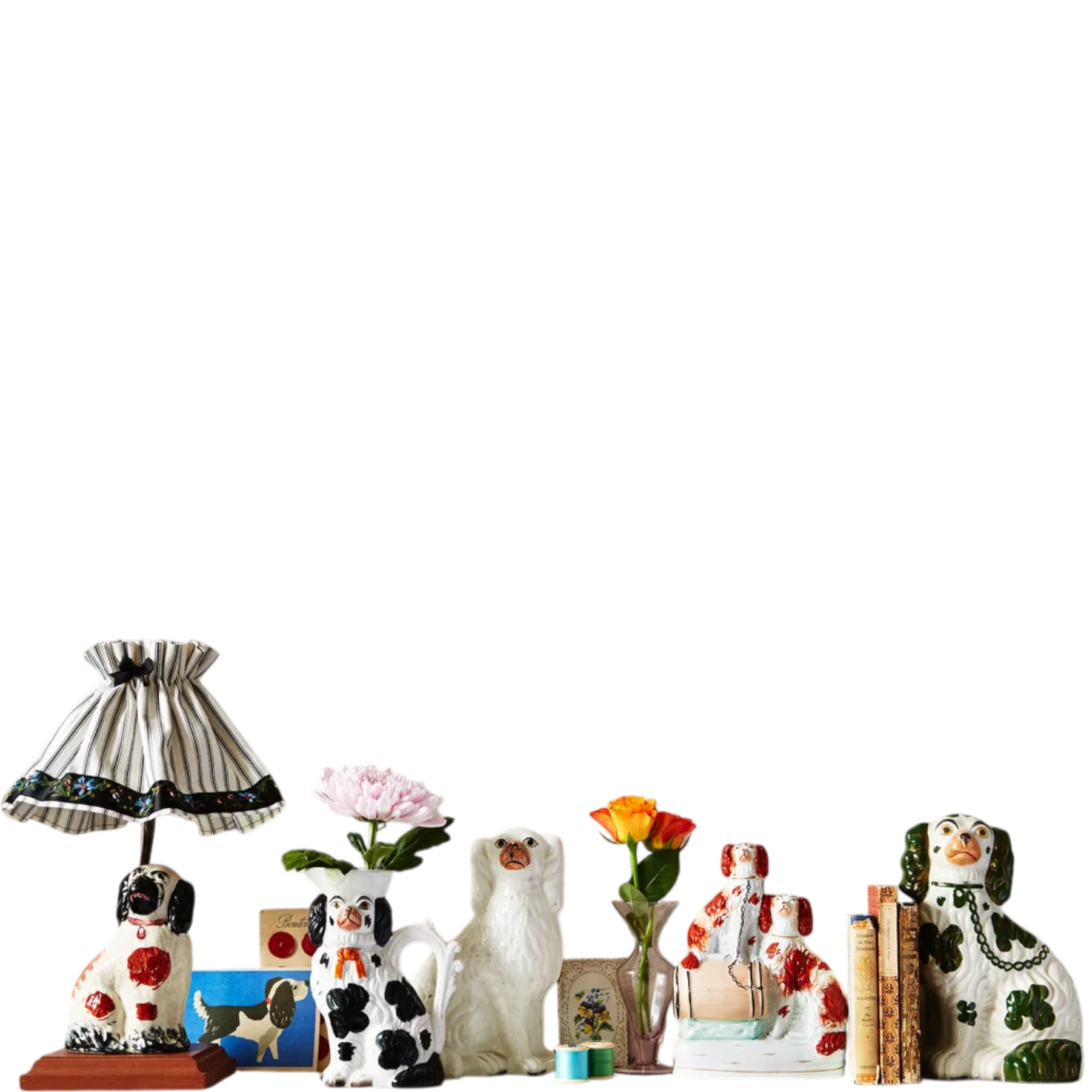
Antique Staffordshire Dogs
Here's a little about the antiques themselves: the theme, the variations, and some notes on collecting.
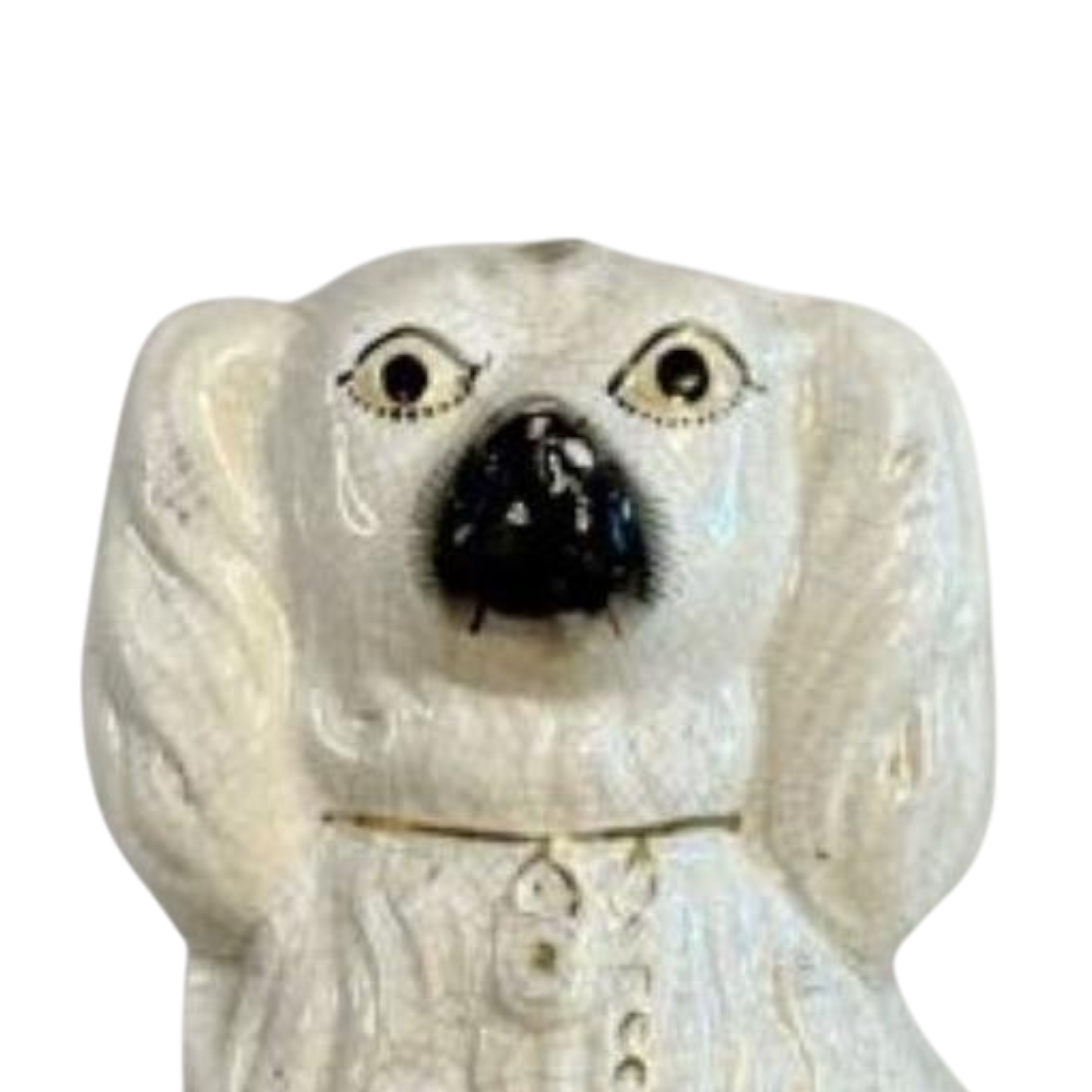
Most spaniels have a base coat of creamy white, rippled with texture. They sit with two paws in front, one visible beneath, and a fluffy tail. Around their neck they sport a collar and locket, with a chain leash hanging down and looping across their backs.

Although some are rounder, most are proportioned to perch comfortably on a narrow mantelpiece: these narrow Staffordshire figurines are known as "flatbacks". Spaniels were originally produced in symmetrical pairs, but today they are often found as singles.
Thanks to the unstudied brushstrokes, each dog possesses an endearing uniqueness which makes it come to life. Even in pairs, no two dogs are the same. They can be cuddly or fierce, whimpering or smug, curious or proud.

To meet the need for novelty, the Staffordshire manufactories constantly came up with variations on the theme.
• Size: Ranging from miniature (2" high) to grand (over 1').
• Coat: Polka dots, splotches, brushed wispies, in rust, copper, gold, brown, or black. Disraeli spaniels have forehead curls; Jackfield are black; and treacle are caramel.
• Eyes: Early dogs see through paint; later through glass.
• Posture: Most have legs molded to the body, but some have separate limbs (which were more difficult and expensive); most are sitting, but others are standing or lying down.
• Use: Most just look pretty, but rare models masquerade as utilitarian objects such as spill vases, ring holders, banks, and pitchers.
• Breeds: Most are spaniels, but you'll also come across pugs, greyhounds, collies, poodles, and Dalmatians.
How to Collect
• The glaze should be crackled from age, not artifice; check that the crazing is neither too even, too complete, nor too obvious.
• Somewhere, usually on the back, there should be an air release hole no larger than 1/8".

• The base should not be open and it should be glazed, not chalky; exceptions include some Jackfield, treacle, early porcelain, and late 19th-C slip-cast models.
• The features of the dog should have life to them and the brushstrokes be detailed, skillful, and spontaneous; the features should not be too deliberate, too heavy, nor too elaborate. Whiskers that curl into mustaches are a dead giveaway for fakes.
It's good to know how to differentiate between the authentically antique, the authentic but new (simply marked "Made in England" or "Staffordshire"), and sly reproductions so you can match price with quality when you collect, but the older I get the less of a purist I become and the more I feel that it's not the dogs' faults if they're reproductions: even the kitschiest of fakes need love too....